What Are the Early Signs of Autism in Toddlers?
You’ve probably compared your toddler to other kids their age more times than you can count. At a playgroup, at daycare pickup, scrolling through a friend’s video of her son stringing together full sentences at 18 months. Most of the time these comparisons don’t mean much. Kids develop on wildly different timelines. But sometimes a pattern keeps showing up, your child doesn’t turn when you say their name, or they don’t point at things the way other toddlers do, or they seem to prefer lining up toys over playing with them, and you can’t quite shake the feeling that something is different.
This guide is meant to help you understand what those differences might mean. It walks through the specific early signs of autism that show up in toddlers, how they differ across age ranges, which signs tend to matter most, and what steps make sense if you’re noticing several of them. Nothing here is meant to diagnose your child. Only a qualified professional can do that. What this guide can do is help you move from a vague sense that something’s off to a clearer understanding of what to watch for and when to act.
Why Early Signs Matter
Autism spectrum disorder is typically diagnosable by around 18 to 24 months, though many children aren’t formally diagnosed until later, sometimes not until they start school. Part of the reason for that gap is that early signs can be subtle, inconsistent, or easy to attribute to normal variation in development. Another part is that pediatricians have limited time during well-child visits to catch everything, and screening tools, while useful, aren’t perfect.
Catching these signs earlier matters because research consistently shows that intervention started before age 3, and especially before age 2, tends to produce stronger long-term outcomes. This isn’t about creating pressure or panic. It’s about giving your child access to support during a window when the brain is especially responsive to learning new skills, rather than waiting until concerns become undeniable.
Social Signs to Watch For
Social differences are often among the earliest and most noticeable signs parents pick up on, even before more obvious language delays appear.
Reduced eye contact. Many toddlers with autism make less eye contact than expected, or their eye contact seems inconsistent, present during a favorite activity but absent during more neutral interactions. This isn’t about a child never making eye contact. It’s about a noticeable pattern of reduced or unusual eye contact across different situations.
Not responding consistently to their name. By around 12 months, most toddlers turn or respond when their name is called, most of the time. A toddler who consistently doesn’t respond, even after several attempts and even when there’s no obvious distraction, is a commonly flagged early sign.
Limited interest in shared attention. Typically developing toddlers enjoy showing things to caregivers, holding up a toy, pointing at an airplane overhead, or looking back and forth between an interesting object and a parent’s face to share the excitement. This is sometimes called joint attention, and reduced interest in it is one of the more well-researched early indicators.
Preferring to play alone. While solitary play is completely normal, especially early in toddlerhood, a strong and consistent preference for playing alone, paired with limited interest in peers even when given clear opportunities to interact, sometimes stands out.
Limited imitation of others. Toddlers naturally imitate facial expressions, gestures, and simple actions modeled by caregivers, like clapping or waving. Reduced imitation, especially of social gestures, is a pattern professionals often look for.
Difficulty with back-and-forth interaction. Simple social games like peekaboo depend on a back-and-forth rhythm between child and caregiver. Some toddlers show less engagement or interest in these reciprocal interactions than expected.
Limited facial expressions directed at others. Smiling, showing excitement, or making other expressions specifically toward a caregiver, rather than just reacting to something interesting, is a form of social communication that can look different in toddlers with autism.
Communication Signs to Watch For
Language and communication delays are often the signs parents notice most clearly, since they tend to become more obvious as a toddler approaches their second birthday.
Limited babbling in infancy. Reduced or unusual babbling patterns before 12 months can be an early sign, though this one is harder for parents to evaluate on their own and is more often noted retrospectively.
No single words by 16 months. Most toddlers say their first meaningful words somewhere between 10 and 14 months. A toddler not using any single words by 16 months is a commonly cited developmental marker worth discussing with a pediatrician.
No two-word phrases by 24 months. By age 2, many toddlers begin combining words into simple phrases, like “more juice” or “go outside.” Absence of this by 24 months is another frequently referenced marker.
Loss of previously used words or skills. This one deserves particular attention. A toddler who was using words and then stops, or who loses other previously developed skills, is a pattern that should be discussed with a professional promptly, regardless of the child’s age.
Limited use of gestures. Pointing, waving, reaching to be picked up, and other early gestures typically develop before spoken language and often serve as its foundation. Reduced use of these gestures by 12 to 18 months is a commonly flagged sign.
Unusual speech patterns. Some toddlers who are talking still show patterns like echolalia, repeating words or phrases either immediately after hearing them or later in a seemingly unrelated context, or a flat, unusual tone of voice that stands out from typical toddler speech.
Difficulty following simple directions. Struggling to follow basic one-step instructions without gestures or visual cues, especially past the age where this is typically expected, can point to a receptive language difference worth evaluating.
Behavioral and Play Signs to Watch For
Beyond social and communication patterns, a number of behavioral and play-related signs often factor into an early evaluation.
Repetitive movements. Hand-flapping, rocking, spinning in circles, or repeatedly moving fingers in front of the eyes are common in toddlers with autism. On their own, these movements aren’t necessarily a concern, since many typically developing toddlers show some repetitive behaviors too, but a persistent, frequent pattern is often part of the broader picture a professional will consider.
Intense focus on parts of objects. Rather than playing with a toy car as a whole, a toddler might become fixated on spinning its wheels repeatedly. This kind of narrow, part-focused interest is a commonly noted pattern.
Lining up toys or objects. Repeatedly arranging toys or objects in lines or specific patterns, rather than engaging in more typical pretend or exploratory play, is a frequently described early sign.
Limited pretend play. Toddlers typically begin engaging in simple pretend play, like feeding a doll or pretending a block is a phone, sometime around 18 months. Reduced or absent pretend play by this age is a pattern often noted during evaluations.
Strong distress over minor changes. Some toddlers react with unusually intense distress to small changes in routine, like a different route to daycare or a rearranged room, well beyond typical toddler resistance to change.
Unusual reactions to sensory input. Being unusually sensitive to sounds, textures, lights, or being unusually under-responsive to things like pain or temperature, are both patterns that can factor into a broader evaluation.
Extremely narrow food preferences. A very limited range of accepted foods, especially when the pattern seems tied to specific textures rather than taste, sometimes comes up as part of a fuller developmental picture.

Nurse-led Sensory Play for Autism
How Signs Differ Across Toddler Age Ranges
Because toddlerhood covers such a wide developmental range, it helps to know roughly what to expect at different points.
12 to 15 months. At this age, early signs tend to center on foundational social communication, limited or no babbling, not responding to their name, limited use of gestures like pointing or waving, and reduced interest in shared attention with a caregiver. Because so much variation is normal at this age, pediatricians typically rely on structured screening tools rather than parent observation alone.
16 to 18 months. Signs at this stage often become somewhat clearer, no single words yet, limited imitation of simple actions, reduced eye contact during play, and a continued lack of pointing to show interest in something. This is also the age range where the American Academy of Pediatrics recommends universal autism-specific screening during well-child visits.
19 to 24 months. By this age, language delays tend to stand out more clearly, no two-word phrases, limited vocabulary growth, and more noticeable social differences like preferring solitary play or limited response to other children. Repetitive behaviors and intense, narrow interests often become more apparent during this window as well.
25 to 36 months. As toddlers approach preschool age, signs frequently become easier to observe in group settings, difficulty playing alongside or with peers, limited pretend play, more pronounced resistance to changes in routine, and communication that hasn’t progressed to short sentences. Many toddlers receive a formal diagnosis somewhere in this age range, since patterns that were harder to interpret earlier often become clearer by now.
It’s worth remembering that every child develops on their own timeline, and a single sign at any age rarely tells the whole story. What matters most is the overall pattern across categories, communication, social interaction, behavior, and play, rather than any one item in isolation.
Signs That Warrant Prompt Attention
While most signs described in this guide are worth monitoring and discussing at a routine appointment, a few patterns are generally considered worth addressing more promptly, without waiting for the next scheduled well-child visit.
Loss of previously acquired words or skills at any age is one of the clearest signals to raise with a pediatrician right away, since regression is a distinct pattern from simply developing more slowly. A complete absence of babbling, gesturing, or any spoken words by 16 months is another pattern worth addressing sooner rather than later. And any behavior involving self-injury, like head-banging or biting oneself, should be discussed with a professional promptly, since it can indicate significant distress or an unmet need that’s worth understanding quickly.
What Screening and Evaluation Actually Involve
If you bring your concerns to a pediatrician, the process usually starts with a structured screening tool. The Modified Checklist for Autism in Toddlers, Revised (M-CHAT-R), is the most commonly used screening tool in the United States and is typically administered at the 18 and 24 month well-child visits. It’s a short parent-report questionnaire, not a diagnostic tool, but a positive result usually leads to a referral for a more comprehensive evaluation.
A full diagnostic evaluation is typically more involved, often conducted by a developmental pediatrician, child psychologist, or a multidisciplinary team. It usually includes direct observation of your child, a detailed developmental history interview with you, and standardized diagnostic tools designed specifically for autism assessment. This process can take several hours and sometimes multiple appointments, and waitlists for developmental evaluations can be long in many areas, which is part of why raising concerns early, rather than waiting to be sure, tends to serve families better.
What to Do If You’re Noticing Several Signs
If several of these patterns sound familiar, a few concrete steps can help you move forward without feeling like you’re navigating this alone.
Write down specific examples. Rather than a vague sense that something feels different, jot down specific observations, dates, and contexts. “Doesn’t respond to his name, tried three times this morning” is more useful to a pediatrician than “seems distracted sometimes.”
Request a developmental screening directly. If your child hasn’t had one recently, or if you have concerns before the next scheduled visit, it’s completely reasonable to call your pediatrician’s office and ask for a screening appointment rather than waiting.
Ask for a referral if concerns persist. If a screening raises concerns, or if your instincts tell you something is worth pursuing further even without a formal screening flag, ask directly about a referral for a comprehensive developmental evaluation.
Look into early intervention services in the meantime. In many states, early intervention programs for children under 3 can begin providing developmental support even before a formal autism diagnosis is complete, based on documented delays alone. This can be a valuable bridge while you’re waiting for a full evaluation.
Talk to your child’s daycare or childcare provider. Caregivers who spend significant time with your toddler in a group setting often have useful observations about how your child compares to same-age peers in social and play situations.
Give yourself permission to trust your instincts. Research consistently shows that parents are often the first to notice early signs of autism, sometimes well before a screening tool catches anything. That instinct is worth taking seriously, even if it’s hard to put into words at first.
Common Misconceptions Worth Addressing
A few widespread misconceptions tend to delay families from acting on early signs, so it’s worth naming them directly.
“Boys develop language later than girls, so it’s probably nothing.” While there is some truth to general differences in early language development between boys and girls, this shouldn’t be used to dismiss a consistent, significant delay. If you have real concerns, they’re worth raising regardless of your child’s sex.
“Einstein didn’t talk until he was four.” This oft-repeated story is more folklore than documented fact, and even if it were entirely true, it describes one exceptional case, not a reliable reason to delay addressing a consistent pattern of delayed communication.
“She’s just shy.” Shyness and social differences tied to autism can look similar on the surface but come from very different places. A shy toddler typically still shows interest in peers and caregivers, just more cautiously. Reduced interest altogether is a different pattern worth distinguishing through professional evaluation rather than assumption.
“If it were really autism, I’d just know.” Early signs are often subtle and inconsistent, which is exactly why structured screening tools and professional evaluations exist. Not immediately recognizing a clear pattern doesn’t mean concerns aren’t valid once you start noticing them.
“Getting him screened means something is definitely wrong.” A screening is simply a tool for gathering information. Plenty of toddlers are screened and show no significant concerns. Screening exists to give you clarity, not to confirm a predetermined outcome.
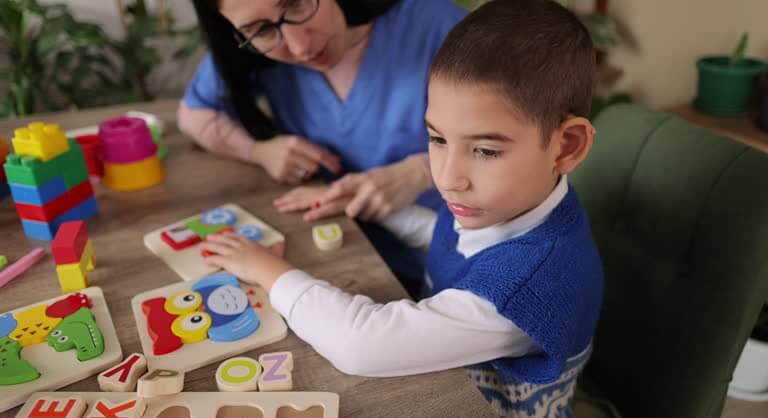
A young boy with autism sits at a table, focused on a colorful sensory toy while a nurse gently guides him.
How to Tell the Difference Between a Sign and Typical Toddler Behavior
One of the hardest parts of this whole process is that toddlers, in general, are unpredictable, inconsistent, and prone to behaviors that can look concerning in isolation. Nearly every toddler has thrown a tantrum that felt too big for the situation, gone through a picky eating phase, or ignored you completely while absorbed in something interesting. So how do you tell the difference between normal toddler behavior and something worth a closer look?
Look at frequency and consistency, not isolated moments. A toddler who occasionally doesn’t respond to their name while deeply focused on a toy is different from a toddler who consistently doesn’t respond across many different situations, moods, and times of day. One instance rarely means much. A persistent pattern across weeks and different contexts is what tends to matter.
Consider whether the behavior is interfering with development or daily life. Lining up cars occasionally during play is common and harmless. A toddler who exclusively lines up objects and shows little interest in any other type of play, to the point that it limits their overall play repertoire, is a different picture.
Compare across multiple developmental areas, not just one. A toddler with a language delay but strong eye contact, clear interest in peers, and typical play skills is often a very different situation from a toddler showing delays across communication, social interaction, and play simultaneously. Autism evaluations look at the whole picture rather than any single delayed skill in isolation.
Notice whether the pattern is stable or improving. Many toddlers go through temporary phases, a few weeks of increased clinginess, a stretch of picky eating, a period of resisting new foods or activities. These tend to shift and resolve over time. Signs associated with autism tend to be more persistent and don’t typically resolve on their own within a few weeks.
Remember that professionals are trained to make this distinction, you don’t have to. You’re not expected to definitively separate typical variation from a genuine concern on your own. That’s exactly what screening tools and developmental evaluations are designed to do. Your job is simply to notice patterns and bring them to someone qualified to interpret them, not to reach a conclusion yourself before that conversation happens.

A little girl sits at a table with a drawing and gouache
What Happens If Your Toddler Is Diagnosed
If a formal evaluation does result in an autism diagnosis, it’s natural to feel a mix of emotions, relief at finally having an answer, worry about what comes next, and uncertainty about how to move forward. A diagnosis is the start of a process, not a final verdict on your child’s future. Many families begin exploring early intervention services and therapies like ABA therapy shortly after diagnosis, and our guide on {Is ABA Therapy Right for My Child? Signs to Look For} can help you understand whether that specific path makes sense once you have a diagnosis in hand.
It’s also worth remembering that an early diagnosis doesn’t define what your child’s life will look like. It simply gives you and your child’s care team accurate information to build the right support around your child’s specific strengths and needs, as early as possible.
Frequently Asked Questions
At what age can autism typically be diagnosed?
Autism can often be reliably diagnosed by 18 to 24 months, though some children aren’t diagnosed until later, sometimes not until school age, particularly if early signs were subtle or inconsistent.
What is the single most common early sign of autism?
There isn’t one single sign that applies to every child. Reduced response to their name, limited eye contact, and delayed language are among the most commonly cited early indicators, but autism presents differently across individual children.
Can a toddler show some of these signs and not have autism?
Yes. Many toddlers show one or two of these patterns without it indicating autism specifically. A professional evaluation is the most reliable way to understand what a specific pattern of signs actually means for your child.
Is regression, losing previously learned skills, always a sign of autism?
Not always, but it’s always worth discussing with a pediatrician promptly. Regression can have several possible explanations, and a professional evaluation can help determine the cause.
Do girls show the same early signs as boys?
Girls with autism sometimes show similar early signs, but presentation can differ, and girls are, on average, diagnosed later than boys, partly because they may develop stronger early social compensation strategies that mask underlying differences.
What should I do if my pediatrician doesn’t seem concerned but I still am?
Trust your own observations and ask directly for a referral to a developmental specialist or a comprehensive evaluation. You’re always entitled to seek a second opinion if you feel your concerns aren’t being fully addressed.
How long does a full autism evaluation take?
This varies, but a comprehensive evaluation often takes several hours, sometimes spread across multiple appointments, and waitlists for specialists can add weeks or months before the evaluation itself even begins.
What can I do while waiting for an evaluation?
Many areas offer early intervention services for children under 3 based on documented developmental delays alone, without requiring a completed autism diagnosis first. Asking your pediatrician about this option can help your child start receiving support sooner rather than later.
Final Thoughts
Noticing early signs in your toddler doesn’t mean you already know the outcome. It means you’re paying close attention, which is exactly what puts you in the best position to get your child the right support as early as possible. Most of the individual signs covered in this guide are common enough on their own that they don’t confirm anything by themselves. What matters is the overall pattern, and a professional evaluation is the most reliable way to understand what that pattern means for your specific child.
If you’ve been noticing several of these signs and aren’t sure what to do next, starting with your pediatrician or requesting a developmental screening is a reasonable first step. And if you’re looking for support once you have a clearer picture, whether that’s a recent diagnosis or ongoing concerns you want to address, Harmony ABA Centers is available to answer questions and help you understand what comes next, without any pressure to commit before you’re ready.