ABA Therapy vs. Speech Therapy: What’s the Difference and Which Does Your Child Need?
If your child has recently been diagnosed with autism or a developmental delay, you’ve probably heard both “ABA therapy” and “speech therapy” mentioned, sometimes in the same conversation, sometimes by different professionals with different opinions on where to start. It’s a confusing position to be in. Both therapies show up on nearly every recommendation list, both involve trained specialists, and both promise to help your child communicate and function more independently.
The truth is that ABA therapy and speech therapy aren’t competing options. They’re different tools built for different (though overlapping) jobs, and many children benefit from both at the same time. This guide breaks down what each therapy actually does, where they overlap, where they differ, and how to figure out what your child needs right now.
What Is ABA Therapy?
Applied Behavior Analysis, or ABA therapy, is a broad, evidence-based approach that addresses behavior, communication, social skills, and daily living skills all under one treatment umbrella. A Board Certified Behavior Analyst (BCBA) conducts an assessment, builds an individualized treatment plan, and oversees a team of Registered Behavior Technicians (RBTs) who deliver direct therapy, often for many hours a week.
ABA therapy covers a wide range of goals depending on a child’s specific needs, including reducing behaviors that interfere with learning, teaching functional communication, building social skills, and supporting independence in daily routines like getting dressed or following a schedule.

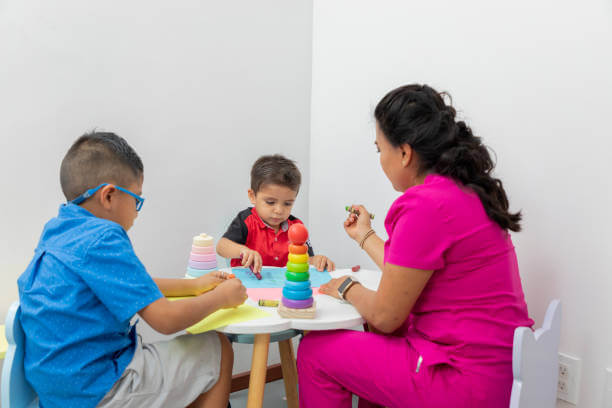
ABA Therapist playing with two children at a table with toys, in her office.
What Is Speech Therapy?
Speech-language therapy is delivered by a licensed Speech-Language Pathologist (SLP), a specialist trained specifically in the mechanics of communication. Speech therapy addresses a narrower, more specific set of goals centered on how a child produces and understands language.
This typically includes articulation and speech sound production, expressive language (putting thoughts into words and sentences), receptive language (understanding what others say), fluency issues like stuttering, and oral-motor skills related to feeding and swallowing when relevant. SLPs are also often the professionals who introduce and train a child on augmentative and alternative communication (AAC) devices when spoken language isn’t a child’s primary mode of communication.
Speech therapy sessions are usually shorter and less frequent than ABA therapy sessions, often ranging from 30 minutes to an hour, one to a few times per week, depending on a child’s specific needs.
Where ABA Therapy and Speech Therapy Overlap
Communication is the biggest area of overlap between these two therapies, which is exactly why families often get confused about which one to pursue. Both ABA therapists and speech-language pathologists work on helping a child request items, answer questions, and use language meaningfully.
The difference is in scope and method rather than the underlying goal. Our guide on How ABA Therapy Helps Children Build Communication Skills covers this in depth, but in short, ABA therapy teaches communication as part of a broader behavioral framework, using techniques like functional communication training, discrete trial training, and natural environment teaching, often across many hours per week and across multiple settings. Speech therapy focuses specifically and deeply on the mechanics of language and speech production, often incorporating specialized techniques for articulation, oral-motor coordination, and language structure that fall outside an ABA therapist’s scope of practice.
Many children see meaningful communication gains from either therapy alone, but the two approaches genuinely complement each other rather than duplicate the same work.
Key Differences Between ABA Therapy and Speech Therapy
Scope of Treatment
ABA therapy addresses a wide range of goals, including communication, but also behavior, social skills, and daily living independence. Speech therapy focuses specifically on communication and, in some cases, feeding and swallowing.
Provider Credentials
ABA therapy is delivered under the supervision of a BCBA, with direct sessions often provided by an RBT. Speech therapy is delivered by a licensed SLP, a specialist with training focused entirely on communication and swallowing disorders.
Session Frequency and Intensity
ABA therapy is often recommended at a high weekly intensity, sometimes 20 to 40 hours per week for young children, because behavioral change tends to require consistent, repeated practice across many contexts. Speech therapy sessions are typically shorter and less frequent, often one to three sessions per week, since the work is more concentrated on specific language and speech targets.
Treatment Setting
ABA therapy can take place in a center, in the home, or in the community, often across multiple settings to help skills generalize. Speech therapy typically takes place in a clinic, a school setting, or occasionally at home, usually in a single consistent location.

Sensory integration therapy. Boy with autism spectrum disorder working with therapist using hedgehog half balls
Underlying Approach
ABA therapy is grounded in behavioral science, focusing on how the environment shapes behavior and using reinforcement to build new skills. Speech therapy is grounded in communication science, focusing on the specific mechanics of how language and speech sounds are produced, processed, and understood.
Signs Your Child Might Benefit From ABA Therapy
ABA therapy tends to be a strong fit when a child is showing:
- Behaviors that interfere with learning, safety, or daily routines
- Difficulty with a broad range of skills beyond just communication, including social interaction or daily living tasks
- A need for intensive, structured intervention across multiple hours per week
- Challenges that seem to span several developmental areas at once
Signs Your Child Might Benefit From Speech Therapy
Speech therapy tends to be a strong fit when a child is showing:
- Delayed or unclear speech sound production
- Difficulty understanding spoken language or following directions
- Trouble putting thoughts into complete sentences
- Stuttering or other fluency concerns
- Feeding or swallowing difficulties
- A need for a dedicated communication device or AAC system
Can a Child Receive Both ABA Therapy and Speech Therapy?
Yes, and for many children, this combination produces the best outcomes. It’s common for a child to attend ABA therapy for the majority of their weekly hours while also seeing an SLP once or twice a week for focused speech and language work. In these cases, the two providers ideally coordinate, sharing goals and progress notes so a child’s communication targets are reinforced consistently across both settings.
For example, if a speech-language pathologist is working on a child’s articulation of a specific sound, an ABA therapist can reinforce and prompt that same target sound throughout the child’s other sessions, giving the child far more practice repetitions across the week than either therapy could provide alone. Similarly, if an SLP introduces an AAC device, ABA therapists can support consistent use of that device across every session and setting, which helps the skill generalize much faster.
The key is communication between providers. If your child is receiving both therapies, it’s worth asking each team whether they coordinate directly or whether that responsibility falls to you as the parent to relay updates back and forth.
Does Insurance Cover Both Therapies?
In most cases, yes, though coverage details vary by plan. Speech therapy is a well-established, commonly covered service under most health insurance plans, often without the same disability-specific mandates that apply to ABA therapy. ABA therapy coverage in Texas is specifically protected under state insurance law for children diagnosed with autism spectrum disorder, which means most plans regulated by the state must cover medically necessary ABA services.
Because both services may draw from the same annual deductible or out-of-pocket maximum, it’s worth understanding your specific benefits before committing to a schedule involving both therapies. For a detailed breakdown of what ABA therapy typically costs and how insurance affects your out-of-pocket amount, see our guide: How Much Does ABA Therapy Cost?
How to Decide What Your Child Needs
The most reliable way to figure out whether your child needs ABA therapy, speech therapy, or both is a comprehensive evaluation. If your child hasn’t yet had a speech-language evaluation, that’s often a natural starting point for identifying specific communication needs. If your child is also showing broader behavioral, social, or daily living challenges, a BCBA assessment can clarify whether ABA therapy is the right next step.
A few practical questions can help guide the conversation with your child’s care team:
- Is the primary concern specific to speech sounds, language, or fluency, or does it span multiple areas of development?
- Does my child need intensive, many-hours-per-week intervention, or would a more focused, lower-frequency approach address the core concern?
- Are there behaviors getting in the way of learning that fall outside a speech-language pathologist’s scope of practice?
- Would my child benefit from an AAC device, and if so, who’s best positioned to introduce and train on it?
There’s no single right answer for every child, and pursuing an evaluation with each type of specialist is a reasonable way to get clarity rather than guessing based on general descriptions alone.
ABA Therapy and Speech Therapy Side by Side
| ABA Therapy | Speech Therapy | |
| Provider | BCBA-supervised, delivered by RBTs | Licensed Speech-Language Pathologist |
| Primary focus | Behavior, communication, social skills, daily living | Speech sounds, language, fluency, feeding |
| Typical intensity | Often 10 to 40 hours per week | Often 1 to 3 sessions per week |
| Common setting | Center, home, or community, sometimes all three | Clinic, school, or home |
| Best fit for | Broad developmental needs spanning multiple areas | Focused speech and language concerns |
| AAC device training | Reinforces device use across sessions | Typically introduces and trains the device |
This side-by-side view is a simplified snapshot, not a strict rulebook. Every child’s situation is different, and a good evaluation from each specialist will give you a far more accurate picture than a general comparison chart ever could.
What Happens During a Typical Session in Each Therapy
Understanding what an actual session looks like can make the decision feel less abstract. A typical ABA session often starts with a warm-up activity, moves into structured skill-building tied to the child’s specific goals, incorporates natural, play-based practice, and wraps up with a parent update covering what was worked on and how the child responded. Sessions can run anywhere from two to six hours, depending on the child’s recommended weekly schedule.
A typical speech therapy session is shorter and more concentrated, often 30 to 60 minutes. It might include warm-up exercises, targeted drills on a specific speech sound or language structure, structured games designed around a language goal, and a short parent debrief at the end covering home practice suggestions. Because sessions are less frequent, SLPs often send home specific exercises for parents to practice between visits.
Neither format is inherently better. They’re built around different treatment philosophies, one favoring high-frequency, high-repetition practice across a broad set of goals, and the other favoring focused, specialized sessions targeting a narrower set of communication skills.

Female therapist checking a young boy
Questions to Ask When Comparing Providers
If you’re trying to decide between starting ABA therapy, speech therapy, or both, a few questions can help clarify the right path for your child:
- Has my child had a comprehensive speech-language evaluation, a BCBA assessment, or both?
- What specific goals would each therapy address that the other wouldn’t?
- If my child needs both, will the providers coordinate directly, or will I need to relay updates myself?
- How many weekly hours does each provider recommend, and how would that fit into our family’s schedule?
- Does my insurance plan cover both services, and how would that affect our deductible or out-of-pocket maximum?
Bringing these questions to an initial consultation, with either an ABA provider or a speech-language pathologist, usually gives you a much clearer answer than trying to research the difference in the abstract.
The Role of Parents in Either Therapy
Whether your child is in ABA therapy, speech therapy, or both, your involvement outside of sessions makes a real difference. Practicing target skills at home, whether that’s a specific speech sound, a new vocabulary word, or a communication strategy from an ABA session, gives your child far more repetition than clinic time alone can provide.
Most quality providers in both fields build parent training or coaching directly into their programs, giving you specific strategies and language to use in everyday routines. Staying in consistent communication with both providers, if your child is receiving both therapies, helps ensure everyone is working toward the same goals rather than pulling in different directions.
How Harmony ABA Centers Approaches Communication Alongside ABA Therapy
At Harmony ABA Centers, communication is one of the core focus areas in nearly every treatment plan, alongside social skills, behavior support, and daily living independence. Our BCBA-led teams build individualized goals based on each child’s specific communication profile, and we’re glad to coordinate with your child’s speech-language pathologist if your family is pursuing both therapies at once.
Our 1:1 therapist-to-child ratio means your child gets focused, consistent practice on their communication goals throughout every session, not just during a dedicated portion of the day. If you’re trying to figure out whether ABA therapy, speech therapy, or a combination of both makes sense for your child, our team can walk you through an assessment and help you understand where ABA therapy specifically fits into the bigger picture.
Frequently Asked Questions
Is ABA therapy the same as speech therapy?
No. ABA therapy is a broad behavioral approach that addresses communication, social skills, behavior, and daily living independence. Speech therapy is a specialized service focused specifically on speech and language development, delivered by a licensed speech-language pathologist.
Should my child do ABA therapy or speech therapy first?
This depends on your child’s specific needs. A speech-language evaluation can clarify communication-specific concerns, while a BCBA assessment can identify broader behavioral or developmental needs. Many children benefit from starting both evaluations around the same time to get a complete picture.
Can a child be in ABA therapy and speech therapy at the same time?
Yes. Many children receive both therapies simultaneously, with ABA therapy addressing a broader range of goals and speech therapy providing focused, specialized work on communication. Coordination between providers helps these therapies reinforce each other rather than working in isolation.
Does ABA therapy replace the need for speech therapy?
Not necessarily. While ABA therapy addresses functional communication, it doesn’t replace the specialized clinical training an SLP brings to articulation, language structure, and feeding-related concerns. Many families use both to address different aspects of a child’s development.
Which therapy does insurance cover more easily?
Both are commonly covered by insurance, though the specifics depend on your plan. In Texas, ABA therapy has specific legal protections for children diagnosed with autism spectrum disorder, while speech therapy is broadly covered as a standard medical service across most plans.
How do I know if my child needs an AAC device?
This is typically determined by a speech-language pathologist during an evaluation, based on your child’s current communication abilities and potential for developing spoken language. Once introduced, an AAC device can be supported and reinforced across other therapies, including ABA sessions.
Final Thoughts
ABA therapy and speech therapy aren’t competing choices. They’re two different tools, each built for a specific purpose, and for many children, the strongest results come from using both together rather than picking one over the other. The right combination depends entirely on your child’s specific needs, which is why a thorough evaluation from each specialist matters more than trying to guess from a general description.
If you’re trying to figure out whether ABA therapy is the right fit for your child, alongside or separate from speech therapy, Harmony ABA Centers is here to help. Contact our team today to schedule a consultation and learn how our individualized programs support children and families throughout Katy and Greater Houston.